Synopsis
Synopsis
- A regex parser & interpreter for a minimal language (subset of
POSIX):r1,r2 ::= ε | a | . | r1* | r1+ | r1r2- I.e. empty string, alphanumeric literals,
.(any such literal), Kleene$\ast$, one-or-more ($+$), concatenation
- I.e. empty string, alphanumeric literals,
- Matches input text on regex in a repl (CLI programme)
- Library for further extension
- Visualizer for underlying datastructure using a markup language
dot
Usage
make          # creates regexp, regexp-test
./regexp      # run programme's repl
./regexp-test # run test suite
When running the repl, it writes locally dfa.dot, nfa.dot,
powerSetDFA.dot which represent the internal data structures.
These are written in the dot
markup and can be compiled to a format free of choice (e.g., SVG, PNG).
Sample usage
>> (ab.)*ab
>? abxabyab
Checking "abcdcd" on "ab(cd)*" results in: True
...
Equivalent DFA
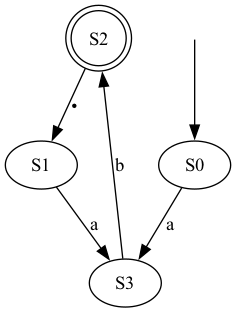
Using the
dotbinary, one can compiledfa.dotviadot -Tpng dfa.dot -o dfa.png
Design
Note: read
API.mdfor further implementation details.
- Our project reads, parses and evaluates a regular expression
- Two main components:
- Parsing: Tokenizing the string
- Evaluation: Producing and running a state machine (equivalent to the string)
Goal: interface match :: RegPattern -> String -> Bool which checks
if given input string matches a regex pattern.
Parsing
- Parsing of strings via
Parsing.hs - Interface:
Parser.parseReg :: String -> Maybe Regex - Tokenizion results in a recursive datatype
Regex:data Regex = Epsilon | Literal Char | Kleene Regex | Concat Regex Regex | Dot
Evaluation
- The tokenized string is translated to a deterministic finite automaton (DFA)
- This requires:
- creating an $\epsilon$-NFA from a Regex,
- creating a DFA from an $\epsilon$-NFA,
- creating an $\epsilon$-closure, and
- creating a cleaned-up DFA from a previous DFA (with multistates).
- Running an input string against the DFA.
-- Top-level API in @Regex@
match :: RegPattern -> String -> Bool
match p s = case P.parseReg p of
    Just reg -> match1 reg s
    _        -> False

match1 :: P.Regex -> String -> Bool
match1 pattern input =
    let dfa = (DFA.fromNFA . NFA.fromRegex) pattern in
        check dfa input

check :: DFA -> String -> Bool
check = ...
checkruns a simple traversal on the DFA, and checks whether it can read the entire sequence and finish in an accepting state.- We branch out whenever we encounter the
.“wildcard” (we handle it explicitly!)